When Desire Becomes a Quest: Saugandhikāharaṇam at the 32nd GKCM Award Festival
 କେଦାର ମିଶ୍ର Kedar Mishra
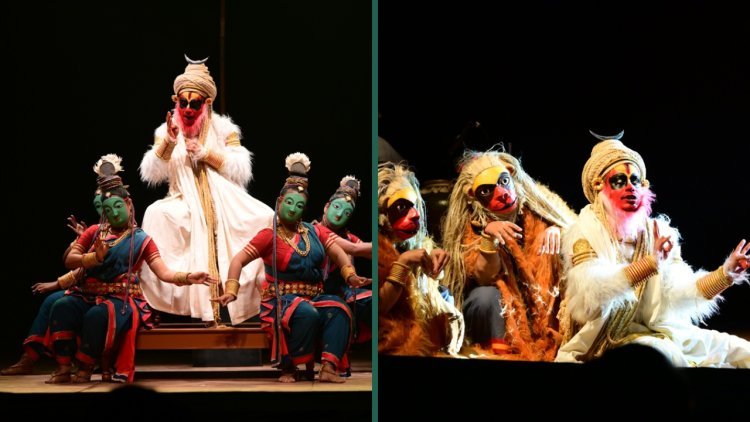
Draupadi is not merely tempted by a flower. She is seized by it. The fragrance of the celestial Saugandhika is so complete—petal, colour, softness, and that hypnotic aroma—that wanting it becomes a kind of possession. In the Vana Parva of the Mahābhārata, this is no idle whim. It is a wish that rearranges the forest around her. For her husband, the wish becomes duty. Bhīma, gigantic, chivalrous, and impatient of delay, must find the mystic bloom. Between Draupadi’s longing and the flower itself stands another presence from an older age: Hanumān of Tretā, old, fragile in appearance, absorbed in devotion—yet still the son of Vāyu, as Bhīma is. Their meeting is comic, then terrible, then illuminating: a kind of viśvarūpa in which the younger brother is made to revisit, with awe, the heroic life of the elder.
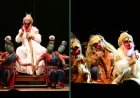
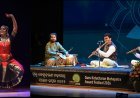
This is the lore of Saugandhikā Haraṇa, long familiar on the Indian stage—most famously in Kathakali, and in Odisha in the living voices of Pala and Daskathia. On the third evening of the 32nd Guru Kelucharan Mohapatra Award Festival, organised by Srjan at Rabindra Mandap, Bhubaneswar, in collaboration with Sri Sri University and in the birth-centenary year of Guru Kelucharan Mohapatra, the story returned in another register: as Mārgānātya, a revitalisation of the ancient mārga tradition of nāṭya drawn from Bharata’s Nāṭyaśāstra. Chidakash Kalalay–Centre of Art and Divinity presented the Sanskrit play.
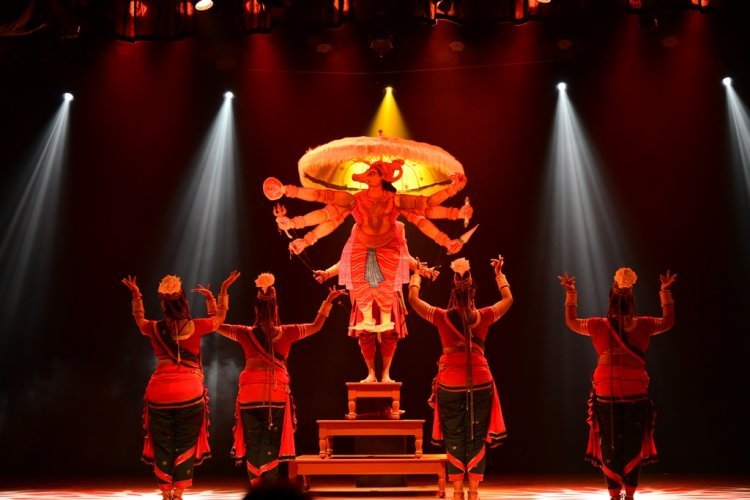
Saugandhikāharaṇam, directed in the Nata-Dharma Parampara by Sangeet Natak Akademi Awardee, Tagore National Scholar and honorary Mahamahopadhyay Dr Piyal Bhattacharya, with live music composed by Sayak Mitra. Bhattacharya is known for reconstructing ancient instruments such as the Vakra Veena and Sage Bharata’s Kutapa orchestra; here that research was not museum display but theatrical breath.
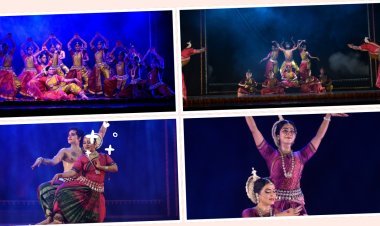
The ensemble carried that arc with unusual clarity. Sayak Mitra played Hanumān; Inderpal Singh, Bhīma; Subhendu Ghosh, Kubera and a young monkey; Amrita Dutta, an Apsarā and a young monkey; Nikhil Bora, the Saugandhikāpushpa itself; Amrita Adhikary, Srijani Biswas, Moumita Dhar and Smriti Majumder, the Apsarās. They were held by a Kutapa orchestra of rare density: Acharya Piyal Bhattacharya on Mizhavu; Durba Sinha Roychowdhury as Gāyikā; Koushik Das on Mārdangik / Mridangam; Rick Mukherjee on Suṣīra Vādya (flute); Avijit Ray on Tataha Vādya (Dhrupadi Rabab); Khokan Das on Pataha (Dholak); and Rudrarup Mukhopadhyaya as Tāla Dhāraka.
Mitra’s Hanumān lifted the evening. The role demands both the comic frailty of an old monkey blocking a path and the sudden immensity of a being who has crossed yugas. He found both without strain. Singh’s Bhīma had the necessary bulk and heat—the man who cannot imagine that strength might itself be a kind of blindness—until the confrontation forces him to look. The Apsarās and the personified flower kept the forest from becoming mere backdrop; they made desire visible.
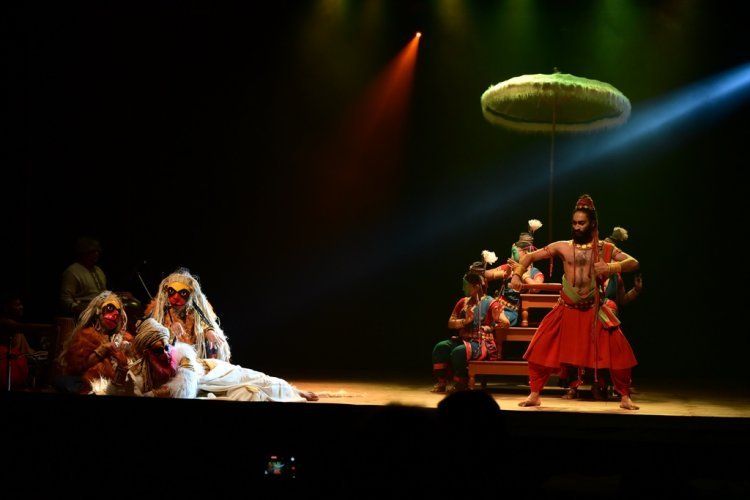
Dr Bhattacharya’s stated emphasis is Nāṭyaśāstra and mārga. What the audience actually received was richer and less purist: a living amalgam in which Desi idioms—Chhau, Prahlāda Nāṭaka and other regional grammars—met classical vocabularies such as Kathakali. That is not a failure of reconstruction; it is how reconstruction becomes theatre. The music, innovative and evocative, did not decorate the action. It argued with it, delayed it, and then released it. Sanskrit speech, reconstructed instruments, and contemporary stage intelligence sat in one room without cancelling one another.
Saugandhikāharaṇam is, at heart, a story about the difference between force and power. Draupadi’s obsession is not mocked; Bhīma’s courage is not denied. What the play insists on—and what this production made felt—is that the flower is only half the prize. The other half is the moment when the son of Vāyu recognises another son of Vāyu, and learns that the path through the forest is not always the one he can smash open. On a festival evening dedicated to a guru who rebuilt a classical form from fragments, that lesson arrived with unusual fitness: tradition not as replica, but as a confrontation that still changes the one who undertakes it. The entire play was elevated with a magical touch of light design by veteran Dinesh Poddar.